


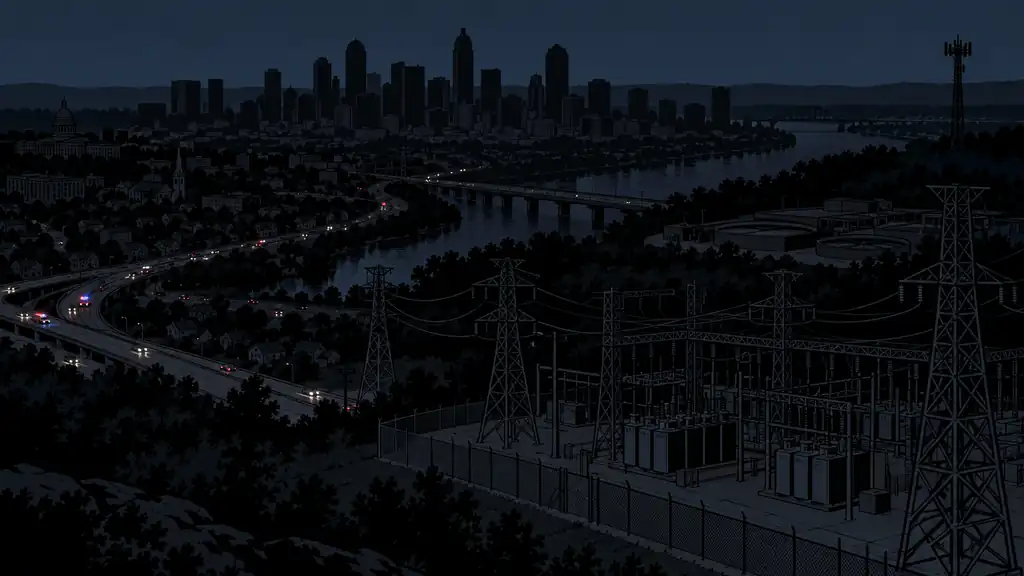
Most people file a grid collapse under “long blackout.” You wait it out, lose the fridge, and the lights come back. That’s the outage you’ve lived through. It is not this threat.
A few hours without power is an inconvenience your house absorbs. A few weeks is a different animal, because time changes what a blackout is. Water, heat, food, medicine, money, phones — all of it runs on electricity, quietly, until the day it doesn’t. Take the grid down across a whole region for weeks and those systems fail one after another. That’s not a blackout; that’s the utilities gone. The darkness isn’t the danger. The cascade behind it is.
If you already handle a two-day outage without thinking about it, this article is about the jump from days to weeks — where the problem stops being “the lights are off” and starts being “can we stay alive here.”
Why time is the whole story
A short outage is survived by leftovers. There’s still water in the pipes, food in the fridge, warmth in the walls, charge in the phone, stock on the shelf. Every one of those is a buffer, and every buffer has a clock. Push past it and the system fails. Here’s roughly the order:
- Water — hours to a couple of days. City water runs on electric pumps, and the utility’s backup generators hold only hours to a few days of fuel. Once that’s gone, pressure drops and the tap goes dry. Water is usually the first thing that can kill you, not the power itself.
- Refrigeration — a day or two. The fridge and freezer go warm. Food spoils, and so do refrigerated medicines like insulin.
- Heat or cooling — days, and it depends on the season. With no grid, the inside of your house drifts toward the outside temperature. In a hard freeze or a heat wave, that’s dangerous within a couple of days.
- Stores and fuel — days. Card readers, ATMs, and gas pumps all need power. Shelves don’t restock. Fuel that exists can’t be pumped.
- Phones and medical — variable. Cell towers run down their batteries. Hospitals and home medical gear strain or fail.
So preparing for a long grid-down isn’t really about electricity. It’s about replacing every utility that quietly ran on it. You’re not buying a flashlight. You’re becoming the water company, the heating company, and the grocery store for your own household.
Put a number on the first one. Four people at two gallons a day — drinking, cooking, basic washing — is eight gallons a day, about 240 gallons a month, and that’s before you flush a toilet or rinse a dish. A case of bottled water is 2.5 gallons. That math is why “I’ve got some water” and “I can run a month” are not the same sentence.
What precedent shows
We don’t have a modern nationwide collapse to point at, and honesty means saying so — the full weeks-long version is extrapolation, not history. But the regional events are real and they all teach the same lesson.
The 2003 Northeast blackout put roughly 50 million people across the US and Canada in the dark. Winter Storm Uri in February 2021 cut power to about 4.5 million Texas homes for up to four days and killed at least 246 people — most of them from the cold, in their own houses. Notice what did the killing. Not the absence of electricity. The exposure, the lack of water, the medical failures downstream of it.
The reason it could run long instead of days sits in a small number of giant machines. After a 2013 sniper attack on the Metcalf substation near San Jose, Jon Wellinghoff — then chairman of the Federal Energy Regulatory Commission — ran the power-flow math and concluded, as reported by The Wall Street Journal, that knocking out just nine of the grid’s most critical substations could black out the entire United States. In a 2013 memo to the White House, Congress, and the Department of Energy, he warned a blackout from lost transformers “could last 18 months or longer.”
Hold that 18-month figure as his worst case, not a forecast. But the reason behind it is plain physics and plain logistics: the big high-voltage transformers these substations run on weigh around 800,000 pounds, only about 20 percent of the ones the US buys are built here, and delivery times have stretched to years since 2021. What a storm or an attacker breaks in an afternoon can take a year to replace. You can’t stockpile fresh water and warmth against that gap after the fact. You do it beforehand or not at all.
The mistakes people make
- Measuring in days when the threat is measured in weeks. A three-day kit is a fine start and a bad finish. Size to weeks.
- Buying power before water. A generator is exciting; water is boring and it’s the thing that fails first and kills fastest. Water leads.
- Forgetting the fuel runs out too. A generator is only as long as its fuel, and the gas station needs power to pump. Anything that renews without a fuel run — solar and a battery — is worth more in a long event than raw wattage.
- Ignoring carbon monoxide. More on this below. It’s the thing that kills prepared people who did everything else right.
What preparedness looks like
Build in the order the failures actually hit you. Each layer also makes ordinary short outages a non-event.
1. Water — first and deepest. Store a real multi-week volume and own a way to make more: a filter, a disinfection method, and access to a raw source. No household stockpiles months of water in the garage, so the real answer is storage plus the means to refill it. Water is the fastest-killing shortfall and the one the grid controls through pumping. It goes first on the list.
2. Food — deep, shelf-stable, low-cook. Weeks of food that needs no fridge and little cooking, plus a grid-independent way to cook it — a propane or wood stove and the fuel to run it. Rotate it as your normal groceries so it stays fresh instead of turning into a science project in the basement.
3. Heat — grid-independent and safe. In a cold climate this is life-or-death within days. A safe heat source, stored fuel to match the season, the ability to close off and warm a single room, and warm bedding. And carbon-monoxide discipline treated as part of the heater, not an afterthought: CO from generators and unvented burning kills about 100 Americans a year (CDC/CPSC). Run any generator outdoors only, at least 20 feet from the house, and put a battery-powered CO alarm in any room with a flame. In a hot climate, plan shade, airflow, and extra water instead.
4. Power for the critical stuff only. Don’t try to run the house. Keep the short list alive: phone and lights, medical devices, and a fridge for food and medicine. A generator with safely stored fuel covers short-to-medium outages. Solar with a battery is the standout for a weeks-long event, because it refills itself when the fuel supply chain is also down. Size it to your critical loads, not your whole panel.
5. Medical depth. Keep a deep reserve of essential medications and a plan for the ones that need refrigeration. A real first-aid kit and the skill to handle small problems at home, because the clinic and the pharmacy may be unreachable exactly when you need them.
6. Skills and neighbors. A long emergency runs on what you can do and who you can lean on. Cooking without power, treating water, heating safely, basic first aid — plus a few neighbors you can pool supplies and watch-shifts with. No household rides out weeks alone as well as a connected one does.
The metric to track isn’t dollars spent. It’s this: how many weeks can your household supply its own water, food, warmth, critical power, and medical care with the grid completely gone? Build that number up on purpose, and everything short of the worst case gets easy.
Bottom Line
- A weeks-long grid-down is a cascade, not a blackout — water, heat, food, medicine, and money fail in order, and that sequence is the real threat.
- Time is the whole story — every buffer in your house has a clock, and the danger starts when the clocks run out. Size your reserves in weeks.
- Water first and deepest — four people is about 240 gallons a month; it fails fastest and kills soonest, so it leads the plan.
- Power only your critical loads, and favor solar-plus-battery for a long event, since it refills without a fuel chain that may also be down.
- Add heat safety, medical depth, skills, and neighbors — CO kills the otherwise-prepared, and readiness is counted in weeks, not dollars.
A short blackout tests your patience. A long one tests your reserves — because it’s the one you can’t improvise your way through once it’s already dark.
Size your reserves with the Food & Water Storage tool, and plan critical-load backup power with the Solar and Generator calculators.