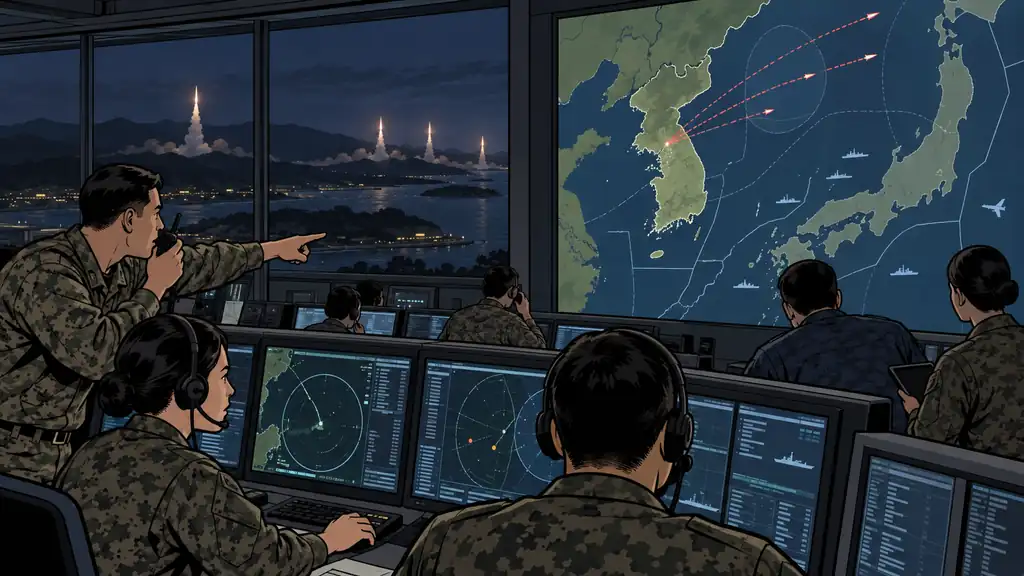
From a Western perspective, North Korea is easy to file away as a strange, backward little nation — a problem for South Korea and no one else. That was a defensible read right up until October 9, 2006, the date of North Korea’s first successful nuclear test. From that morning forward the country belonged to a club that only nine nations on earth have joined. Today it is estimated to hold up to 50 nuclear warheads — and, more to the point for anyone reading this in the United States, a way to deliver them here.
That’s the part most people miss. The threat isn’t that North Korea is powerful in the way the U.S. or China is powerful. It’s that a small, isolated, unpredictable state now sits on capabilities that used to be the exclusive province of superpowers. Low odds, enormous impact — which is exactly the category of threat that earns a place on your list even when your gut says “that’ll never happen.”
Why this is a “major threat,” not a headline
This site sorts threats by two things: how likely they are, and how badly they’d hurt you. North Korea scores low on the first and very high on the second. That combination is precisely why it can’t be waved off. A direct North Korean attack on the U.S. homeland is unlikely in any given year. But the effect — nuclear detonation, an EMP, a wider war that drags in allies — is so large that ignoring it is a planning error, not prudence.
So read the rest of this the way an engineer reads a fault tree: not “will this happen tomorrow,” but “what is the mechanism, and what does it demand of me if it does.”
A war that never actually ended
The Korean War ran from June 1950 to July 1953 and cost the lives of over 36,000 U.S. soldiers. It’s often called “the forgotten war,” and the most important thing to remember about it is how it stopped: not with a peace treaty, but with an armistice — a cease-fire. No treaty was ever signed.
The practical consequence is that North Korea is, technically, still at war with South Korea and — by extension, given our commitments — with the United States. That’s why we’ve kept a military presence on the peninsula for over 70 years, with roughly 28,500 troops stationed there today. This isn’t ancient history. It’s an unresolved conflict on a hair-trigger, sitting frozen for seven decades.
A leader backed by something like a religion
North Korea’s leadership matters here because capability plus intent is what makes a threat real, and intent runs through one man. Since the war, the Kim family has built a cult of personality that’s hard to overstate. Kim Il Sung was the revered “great leader”; his son Kim Jong Il pushed state propaganda casting the family as godlike, and in 1996 reportedly required schools to build dedicated rooms — “research institutes” — for lectures deifying him, with an estimated 40,000 of them across the country.
Kim Jong Un inherited that machine in 2011. After roughly 70 years of indoctrination and isolation, a population of some 28 million largely regards its leader as near-divine and will follow him. As Lord Acton said, “power tends to corrupt and absolute power corrupts absolutely” — one man with near-absolute authority, unconditional public support, and nuclear weapons.
That intent isn’t static, either. In January 2024, addressing the Supreme People’s Assembly, Kim Jong Un dropped the decades-old goal of peaceful reunification and reframed the South as an enemy state, stating the wartime aim of “completely occupying, suppressing, and reclaiming [South Korea] and incorporating it into the territory of our Republic.” Reunification talks — bilateral agreements were signed in 2000, 2007, and 2018 — have effectively been abandoned by both sides.
The conventional threat: mostly aimed at Seoul
Before the nuclear question, understand the conventional one, because it shapes how any crisis would unfold. North Korea has an estimated 5,700 pieces of long- and medium-range artillery dug in along the border, aimed at South Korea. Seoul sits only about 25 miles from the DMZ and holds roughly 9.6 million people. Even a fraction of those launchers could put ~14,000 shells into Seoul in an hour, killing approximately 130,000 people.
Their navy is a study in mixed results — a brand-new 5,000-ton destroyer capsized at launch in May 2025 — but their submarine fleet is a genuine concern, one of the world’s largest at an estimated up to 90 boats. Most are older diesel subs, but some are modern enough to launch ballistic missiles, which means an attack could theoretically originate from just off a coastline rather than from the far side of the Pacific.
The part that reaches you: missiles and EMP
Here’s what actually changes the calculus for a household in Kansas or Ohio. Over the last two decades North Korea has tested short-, medium-, and intercontinental ballistic missiles (ICBMs), and the latest projections indicate they can reach nearly any part of the United States.
Worse, from a defender’s standpoint, those missiles are launched from mobile road- and rail-based platforms and normally hidden in underground bases. That makes them very hard to eliminate in a preemptive strike — which means even a North Korea that got hit first would likely retain the ability to launch a nuclear retaliatory strike. There’s no clean “take out the launchers” option.
Then there’s the scenario that should interest preppers most, because it’s the one that doesn’t require anyone to be near a blast. North Korea launched its first satellite in December 2012 and several since. A couple of them reportedly follow an odd north-to-south orbital track straight over the middle of the United States. They may simply be spy satellites. But some have speculated that a satellite could carry a nuclear device intended to deliver an electromagnetic pulse (EMP) over the continent.
I flag the EMP theory not because it’s proven — it isn’t — but because it’s the one North Korea scenario where the preparedness response is concrete and worth doing regardless of who might cause it. A high-altitude EMP is a grid-and-electronics problem, and it’s the same problem whether the source is North Korea, a solar storm, or anyone else.
You can’t out-prep an ICBM. But the effects North Korea could cause — a lost grid, a nuclear event, a wider war — are the same effects you’d prepare for anyway. Prepare for the effect, not the flag on the missile.
What to actually do about it
This is the honest part. You have zero control over Pyongyang, and there’s no gear that stops a warhead. So the work is entirely on the effects side, and almost all of it overlaps with prep you should be doing for more likely threats.
- Rate it, then right-size it. On a likelihood-and-impact basis this is low-probability, high-impact. It earns a spot on your threat list — but it should not crowd out the boring, likely emergencies (job loss, weather, outages) that are far more likely to actually hit you. Put it in proportion.
- Treat EMP as a grid-down problem you can plan for. Protect a minimal set of critical electronics, know how you’d operate for weeks without the grid, and don’t let the exotic delivery method distract from the ordinary fix: water, food, power, sanitation, and comms that don’t depend on the network.
- Understand the nuclear effects near you. If you’re near a plausible target — a major city, a military base, a port — know what blast, fallout, and prevailing winds would mean for your location and your shelter-in-place-versus-leave decision.
- Watch the peninsula as a leading indicator. A frozen war that flares, a collapse of the reunification posture, or artillery on Seoul would all precede any homeland scenario. It buys you warning time if you’re paying attention.
None of that is North Korea-specific, and that’s the point. The most rational response to a low-odds, high-impact adversary threat is to build the durable, all-hazards base — and let this scenario ride on top of it for free.
Bottom Line
- The threat became real in 2006 and reached the U.S. with ICBMs since. A “backward little country” now holds an estimated up-to-50 warheads and mobile, hard-to-preempt delivery. Treat it as low-probability, high-impact — on your list, in proportion.
- You prepare for effects, not intentions. Grid loss, nuclear fallout, and a wider war are the outcomes to plan for, and every one of them overlaps with prep you should already be doing.
- EMP is the concrete takeaway. Whether or not the satellite theory holds, a grid-down, electronics-down plan is worth building — and it defends you against several threats at once.
- Keep proportion. Don’t let a dramatic, rare scenario pull attention and dollars away from the ordinary emergencies that are far likelier to reach your household first.
Read the North Korea aggression threat brief for the full rating, then pressure-test the two effects that matter with the EMP simulator and the nuclear detonation simulator for your own location.