


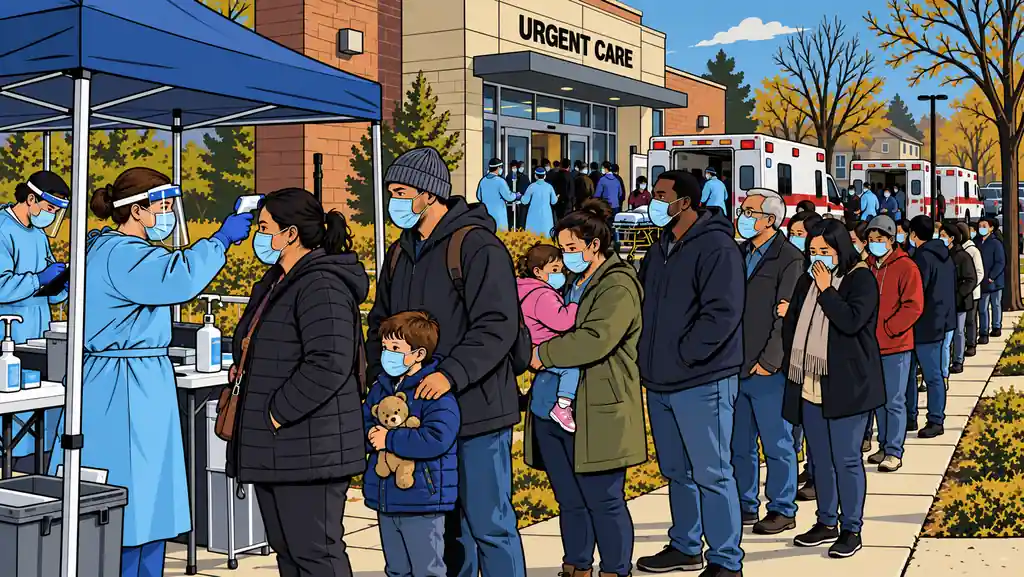
Anyone who lived through the Covid-19 pandemic already learned the core lesson, even if they never put it into words: the household that could stop leaving the house had a completely different few weeks than the one that couldn’t. A regional outbreak — the local, contained version that never goes national — is the exact situation where that pays off, and it pays off cheaply if you set it up early.
Here’s the reframe that does the work. In a regional outbreak, the illness usually isn’t the thing that gets you. Needing to go out is. Every trip to the store or pharmacy while a bug is spreading is a roll of the dice, and it comes at the worst possible time — right when everyone else is out there too, breathing the same air and picking over the same shelves. So the whole game is building one thing: the ability to not leave the house for a couple of weeks without it turning into a crisis. Build that, and the outbreak stops being a threat you’re exposed to. It becomes a problem you can just opt out of.
What “regional outbreak” actually covers
This is the middle band of disease trouble — bigger than one family’s flu, smaller than a national pandemic. It’s a severe respiratory season filling the local ICUs, a foodborne or waterborne outbreak traced to one product, or a new bug that health authorities have so far kept contained to one area. A few things stay true across all of them, and they shape what you do:
- It spreads through contact. Doesn’t matter if it’s respiratory, fecal-oral, or something you pick up off a surface — your risk goes up the more you’re around infected people and the stuff they’ve touched. Cut your contact roughly in half and you cut your exposure roughly in half. It’s that direct.
- The system is strained, not broken. Hospitals may be full, the pharmacy may be out of a specific thing, the store may be picked over — but the lights are on and 911 still answers. That’s not a collapse; that’s a stress test on your household.
- It’s a preview. Most regional outbreaks stay regional. A few are the opening act of something bigger. Getting ready for the small one is the same work as being ready for the big one — just done early and calmly instead of in a panic.
This is normal life, not a freak event
Regional outbreaks aren’t a rare shock you prepare for once a decade. They’re a recurring feature of every year. The CDC estimates seasonal flu alone causes 9 to 41 million illnesses and 12,000 to 52,000 deaths in the US every single year.
The pattern repeats too. The first shortages are predictable and specific — masks, hand sanitizer, fever reducers, certain common generic drugs — and they clear the shelves within days of the news going public. The households that did best had already cut their need to be out there. And the other repeated lesson is about information: the people who acted on the first credible warning beat the people who waited, because by the time it’s obvious, the shelves are already empty and rumor has filled the gap the health department left.
The odds: middling and recurring, not dominating
On a 1-to-9 scale this sits in the lower-middle. Some notable regional outbreak happens somewhere most years. The odds that your area gets a serious one in a given year are moderate; the odds it grows past manageable are lower still. What moves your number:
- How dense and connected you are. Crowded, high-traffic, well-traveled places seed and spread faster.
- Local vaccination and hospital capacity. An under-vaccinated pocket next to a hospital already running full turns a contained problem into a real one.
- Who’s under your roof. Someone immunocompromised, elderly, very young, or chronically ill raises your stakes and lowers how much exposure you can shrug off.
- What you do all day. Healthcare, teaching, and other high-contact jobs mean more exposure — and make the stay-home capability worth more to you.
Honest read: this isn’t the threat that should dominate your year. It’s just common enough and cheap enough to handle that skipping it makes no sense.
What actually goes wrong
For a household that’s ready, a contained outbreak is manageable — you pull back, ride it out, eat some inconvenience. For one that isn’t, the same event can turn serious, and it’s usually not the disease that does it. It’s the chain reaction:
- Care gets harder. If the hospitals are full, routine care backs up and you’re managing more at home — which only works if you’ve got the supplies and the basic know-how.
- The resupply trap. Running out of something essential and having to go get it is the whole failure mode. It spikes your exposure at the worst moment and adds you to the shortage. Every trip you don’t have to make is risk you just deleted.
- Household spread. Once one person’s sick, the house itself becomes the place it spreads. With no plan, one case quietly becomes three or four, and the whole ordeal drags on twice as long.
Building the stay-home capability
Think of it in four parts: stay, treat, isolate, inform.
Stay — the no-resupply window. Build the ability to not leave the house for two to three weeks without it becoming a problem. Do the math instead of guessing. Four people at two gallons of water a day is eight gallons a day — about 170 gallons for three weeks, before you refill a drop. Food is the same idea: three weeks of meals your family actually eats, stuff that keeps. And don’t forget the stuff that quietly forces a trip when it runs out — pet food, diapers, toilet paper, the prescription that’s down to three days. Stock all of it to the same window. This isn’t hoarding; it’s cutting the cord between your household and the store for exactly the weeks that being in the store is dangerous.
Treat — handle ordinary illness at home. The goal is to keep a normal sickness from turning into a reason to walk into a strained hospital.
- Fever and pain reducers, a thermometer that works, oral rehydration solution (or the mix to make it), cough and cold basics, and a real first-aid kit.
- A buffer of every prescription someone in the house depends on. Refill ahead of need, not the day you run out — pharmacy access and drug supply are exactly what tighten in an outbreak.
- And know the flip side: the warning signs that do mean you go get care despite the risk — trouble breathing, dehydration you can’t fix, a high fever that won’t quit. Being ready includes knowing when staying home is the wrong call.
Isolate — keep it from going through the house.
- Soap, hand sanitizer, surface disinfectant, gloves, and a supply of masks or respirators.
- A sick-room plan worked out in advance: which room, and ideally which bathroom, gets handed to whoever’s ill, plus a routine for their laundry, dishes, and the surfaces everyone touches. The point is to hold it at one case instead of watching it walk down the hall.
- Handwashing and surface habits you’ve actually practiced, not ones you’ll invent mid-outbreak.
Inform — pick your sources before you need them. Decide now which sources you trust — your local or state health department, established medical guidance — and act on the first credible warning. Moving before the panic-buying wave is what gets you the supplies and the lead time. In the gap before real guidance shows up, bad information travels faster than the bug, so don’t let rumor set your schedule.
Bottom Line
- The illness usually isn’t what gets you — needing to go out is. Build the ability to stay home for two to three weeks and the outbreak becomes something you opt out of.
- Cut contact, cut risk, almost one-for-one. Every trip you avoid is exposure removed and a shortage you didn’t feed.
- Stock the no-resupply window — food, water, and the boring stuff that forces a trip — plus a prescription buffer refilled ahead of need, not at empty.
- Plan the sick room before you need it so one case at home doesn’t become the whole household.
- Act on the first credible warning, and treat this regional outbreak as a cheap dress rehearsal for a national one.
The prepared household doesn’t beat the outbreak. It opts out of it — by already owning everything that would otherwise force it back out into the spread.
Size your two-to-three-week no-resupply window — food, water, and medical stores — with the Food & Water Storage tool.