


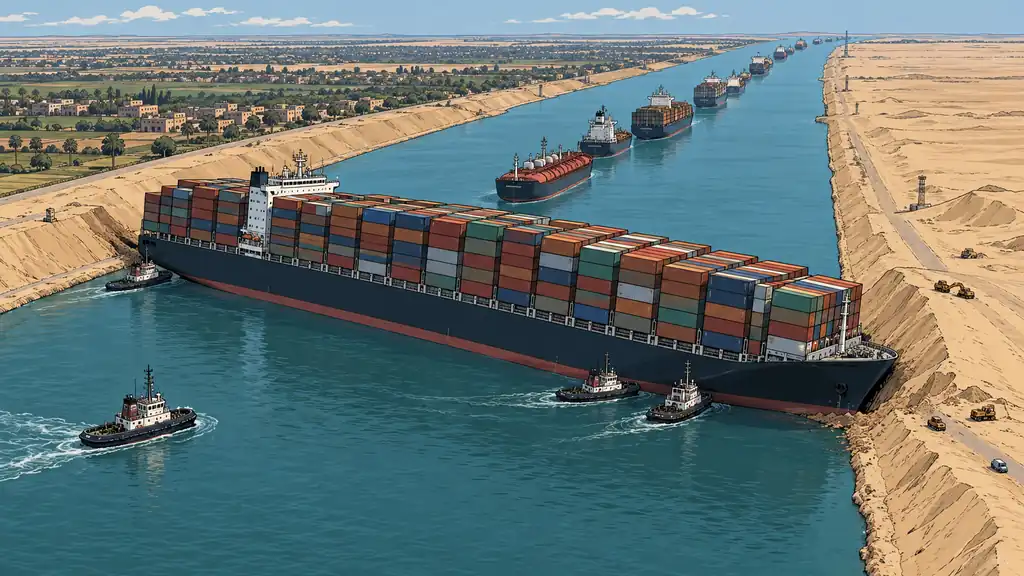
Most of the world’s trade travels by sea, and nearly all of it squeezes through a handful of narrow passages — a few big canals and straits. When one of them closes, the ships don’t stop. They take the long way around. That reroute adds days to weeks to every affected voyage, which means the same fleet completes fewer trips and each trip is more expensive, which means less shipping to go around, which pushes freight costs up, which finally shows up on the shelf as higher prices and the occasional gap — weeks or months later. That’s not a shock. That’s a slow squeeze, and it’s paid in time, not in a single bad night.
That tempo is the whole story here. On a 1-to-9 scale this rates 4 for impact and 6 for likelihood — a Possible, currently-active risk with modest damage — and its defining feature is that it arrives slowly and in plain sight. Almost every threat on this site hits without warning. This one knocks for weeks before it comes in. That makes it the rare one you can very nearly wipe out ahead of time, with nothing more exotic than a deeper pantry and a little attention.
Why it earns a spot on the list
Prepping is about facing real threats in honest proportion, and this one sits low on damage and moderate odds. It’s here not because it’s dangerous but because it teaches something and because it’s cheap to handle. It shows you how much your household leans on systems you’ll never see: your pantry, your medicine cabinet, and your toolbox all depend on ships threading through water on the other side of the planet. Understand that, and understand how easily a small standing reserve absorbs it, and you’ve learned the pattern for a whole class of slow economic trouble.
I also want to note that this threat can be caused by other threats in the same way the current closure is related to conflict with Iran. Understanding the secondary effects of any threat is important and this is just an obvious example.
What history shows
The world’s critical chokepoints are few and well known, and each has been blocked or threatened one way or another — a ship run aground sideways, a regional conflict, a political closure, or attacks that scare carriers into rerouting on their own. The consequences rhyme every time:
- Voyages get longer as ships divert to a slower route.
- Voyages cost more due to increased fuel costs and crew wages.
- The same fleet finishes fewer trips, so effective shipping capacity drops and supply tightens.
- Freight rates climb, and insurance climbs for any water that suddenly looks risky.
- Prices and availability of the affected goods drift over the following weeks to months, then settle back once the route reopens or the market fully adjusts.
The recent cases make it concrete.
- The Suez Canal — roughly 12 to 15% of global maritime trade — was fully blocked for six days in March 2021 when the Ever Given ran aground.
- From late 2023, Houthi attacks in the Red Sea cut Suez traffic by about half in early 2024 and pushed carriers onto the Cape of Good Hope route, adding 10 to 14 days to every Asia-to-Europe voyage.
- A historic drought at the Panama Canal in 2023 forced authorities to cut daily crossings from 38 down to about 20.
- The Strait of Hormuz, which carries roughly 20% of the world’s petroleum liquids (EIA), sits under recurring closure threats. Different causes — accident, conflict, drought, politics — same signature every time: reroute, capacity crunch, a slow drift in prices and availability.
The reassuring read: for the United States, these are disruptions, not catastrophes. Real, broad, expensive — and survivable, and, best of all, something you can see coming.
What it actually does
- The closure. A chokepoint gets blocked, closed, or made too risky to cross — by accident, conflict, or a political decision.
- The reroute. Ships divert to a longer path, adding transit time and fuel to every voyage.
- The capacity crunch. Longer voyages tie up ships and containers, so less cargo moves. Freight and insurance rates rise.
- The slow ripple. After a lag of weeks, those higher costs and delays reach the store: affected goods cost more and occasionally run short. Stores keep little inventory on hand these days, so the delay reaches the shelf faster than it would have when warehouses were full.
- The recovery. The market finds substitutes, reroutes, and eventually the chokepoint reopens; prices ease back. The whole arc plays out over months, not days.
It’s real, but it has a ceiling. This is pressure — a steady tax on the affected goods — not a cliff.
What preparedness looks like
You’re buying one thing: the ability to shrug off a slow price-and-availability squeeze. A modest deeper pantry plus a little attention delivers almost all of it. Three moves do the work.
1. Keep a deeper stock of the imports you actually rely on. Think about the goods you use that come from far away and by a vulnerable route — certain foods, specific medications, particular household items and consumables. Hold a deeper reserve of those. And do the arithmetic on the timescale, because it’s the whole game: a rerouting event plays out over roughly three months historically, so if you keep three months of the coffee, the rice, and the maintenance medication you go through anyway, you consume the entire squeeze at last year’s prices and barely notice it happened. That’s not hoarding; that’s ordinary deep-pantry logic aimed at a squeeze you can see coming.
Push the idea past food where it counts. A longer runway on regular medications and hard-to-replace supplies is the higher-value version of the same move, because with those the risk is availability, not just a few extra dollars.
2. Expect a slow squeeze, not a shelf-clearing. This threat does not empty stores overnight, and treating it like it does — panic-buying — is how you personally help empty a shelf that wasn’t going to empty. Knowing it’s slow is what lets you respond calmly: top off a little on the things that matter, and otherwise carry on.
3. Keep a light eye on the routes you depend on. Because this one telegraphs itself, a little attention pays off. If you rely on goods from a particular part of the world and you see credible news of a chokepoint being disrupted, that’s your cue to deepen the relevant reserve before the price and availability effects show up — you’re getting ahead of a slow event that announced itself weeks in advance. Don’t over-invest here; watch the routes that actually touch what you buy, and ignore the ones that don’t.
Bottom Line
- A chokepoint closure is a slow squeeze paid in time — reroute, capacity crunch, then a gradual drift in prices and availability over months.
- Its impact is low and bounded (4/9): things cost more and take longer, but nothing threatens your safety.
- Its whole character is slow, visible onset, which makes it one of the very few threats you can almost completely head off with a little foresight.
- The core move is a deeper reserve of your import-dependent essentials — food, medications, hard-to-replace goods — measured in weeks to months to match the disruption.
- Stay calm and attentive: keep a light eye on the routes you depend on, top off ahead of the squeeze, and never panic-buy.
This is the threat that knocks slowly before it comes in. A deeper pantry means that by the time it arrives, you’ve already answered the door.
Identify your import-dependent essentials and build a right-sized reserve with the Food & Water Storage tool.