


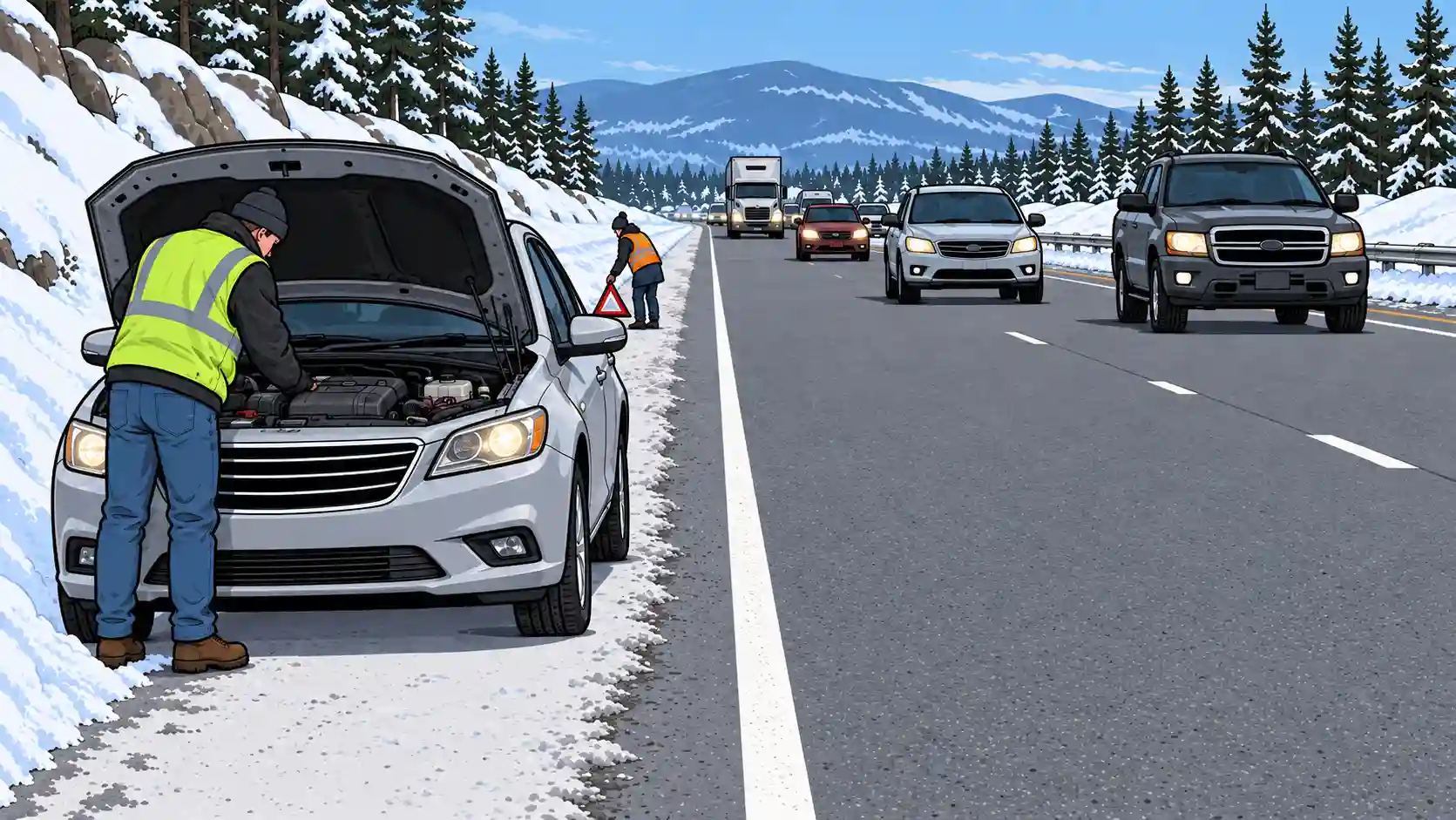
The one threat likely to actually hurt you this decade isn’t the hurricane or the grid going dark. It’s the drive you’ll take tomorrow.
A breakdown or a crash isn’t a rare tail event. Over a driving life it’s a near-certainty, and it happens more than once. That’s not bad luck; that’s just what machines and shared roads do. The only thing you get to decide is whether each one costs you an afternoon or a night in the cold — and you decide that in the driveway, not on the shoulder.
This threat scores 7 for likelihood and 6 for impact on the 1-to-9 scale. High odds, middle consequences — because the outcome runs all the way from a wasted afternoon to a fatal crash or a freezing night stranded. Average across that whole range and impact lands in the middle. Your job is to squeeze the range: make the common case boring and the rare bad case survivable.
Why it ranks near the top
Preparedness is triage. You spend against a threat in proportion to how likely it is times how bad it is — not how dramatic it looks on TV. Run that math and a roadside failure beats almost everything else on the personal list. The once-in-a-lifetime disaster you lie awake over will, most years, do nothing. A car will strand somebody you know this year.
Two different things break, and they need different fixes. The car quits — a flat tire, a dead battery, a belt, the cooling system, fuel. You drive that down with maintenance. Or someone hits you — their mistake, or ice, or a deer — and now it’s your problem. You can’t maintain that away, so you plan to survive it instead. Two problems, two budgets.
The scale, plainly
You’ve lived this or watched it — the flat in the rain, the dead battery in a parking lot, the rear-end at a light. But the numbers say it out loud. NHTSA counted roughly 6.1 million police-reported crashes in 2023, with an estimated 40,901 people killed and about 2.4 million injured — one death every 13 minutes. And that’s only the crashes. The plain breakdowns dwarf them: AAA alone answered more than 28 million roadside-assistance calls in 2024, mostly dead batteries, flat tires, and lockouts.
The pattern in all of it is the same: the people who came through calm weren’t lucky. They were equipped. They had a way to stay warm, a way to be seen, a way to call, and a plan for getting home. The people who had a bad night usually had none of it in the car.
The failure isn’t the danger — the wait is
The breakdown itself rarely hurts you. What hurts you is the chain that follows:
- You’re stopped where you didn’t choose. A shoulder, a median, a dark stretch of county road. Where you stop now sets your risk.
- You have to reach someone. That means a phone with charge and a signal. A dead battery or a dead zone turns a 30-minute wait into an ordeal.
- The weather goes to work on you. This is the real killer in the serious cases. A stalled car in winter is an uninsulated metal box, and without heat you get cold in short order. Summer does the opposite, even faster. And standing next to fast traffic on a narrow shoulder is its own way to get seriously injured or killed.
Every link in that chain gets easier with a little gear and a little planning, and worse without it.
Worked example: size the kit to the bad night, not the average day
Most people pack for the afternoon they expect. Pack for the night they don’t. Say you’re stranded after dark in the cold and help is three to twelve hours out — a real range on a rural road in bad weather. For two people, that’s:
- Medical: The supplies and skills necessary to treat the injuries sustained during a crash, or while changing a tire.
- Water: a couple liters each — call it 4 liters in the car.
- Calories: a few dense bars each, 1,000 to 1,500 calories total, so nobody’s running on empty and making bad decisions.
- Warmth: a wool or synthetic blanket or bag per person, plus hats and gloves — enough to stay warm with the engine off, because you may not be able to keep it running.
- Light and being seen: a headlamp plus reflective triangles or LED flares set out behind the car.
- Power: a charged battery pack so the phone — your one rescue tool — lasts the whole wait.
- Tools: simple tools that allow you to fix a loose battery connection or other simple problems yourself. Don’t forget a good pair of work gloves.
That’s a small amount of gear. It’s the difference between a boring night and a dangerous one.
The common mistakes
- Counting a spare you’ve never checked. A flat spare or a missing jack is not a plan. Better yet, carry a plug kit and a 12-volt inflator — they fix most punctures on the shoulder without a jack at all — but only if you know how to use them.
- Making the phone your whole comms plan. Phones die and dead zones are everywhere. Know where yours drop on your regular routes.
- Servicing on noise instead of schedule. Most batteries and belts strand you with no warning sound. Service on the interval, not when something complains.
- Packing for the average day. The average day needs nothing. Size the kit for your worst plausible night — the cold, remote, after-dark version.
- Forgetting medical. Medical supplies should be in every vehicle for a host of reasons other than this threat.
What preparedness looks like
You’re buying two things: fewer failures (maintenance) and a stranded state you can survive and get out of (kit and plan).
Maintain the machine — it’s the cheapest prep there is.
- Tires: right pressure, real tread, a usable spare. Most blowouts are worn or underinflated tires.
- Brakes and fluids: on the maker’s schedule, not when they squeal. Overheating and low oil strand you far from a garage.
- Battery: test it before winter and age it out on purpose. Cold kills weak batteries with no warning.
Carry the kit above — sized to the worst night, not the average.
Keep the tank above half. Half a tank is still a hundred-plus miles of range in most cars — range to reach help, range to leave a bad spot, and in winter, hours of cabin heat. Refuel at half, not at empty.
Have a get-home plan. Decide now what you do if the car dies 20 miles out and can’t be fixed: who you call, whether you have roadside assistance, and — for the real worst case — whether you could walk it. Keep enough in the car (real shoes, water, a map) that walking out is an option instead of a gamble.
Bottom Line
- A breakdown or crash is one of the emergencies you’re most likely to actually face — near-certain over a driving life. Fund it like it’s real, because it is.
- Impact runs from trivial to fatal. Your job is to squeeze the range: boring common case, survivable bad case.
- Maintenance is prevention. Tires, brakes, fluids, and battery on schedule stop most strandings before they start.
- The kit’s whole job is the wait — water, warmth, light, a way to be seen, first aid, and a charged phone. Size it for the bad night.
- Keep the tank above half and carry a get-home plan, so a dead car far from home is a known procedure, not a crisis.
The car will fail you eventually — that’s physics. Whether that failure costs you an afternoon or a night in the cold is a decision you make in the driveway.
Keep your kit contents in the Vehicle Inventory Tool