


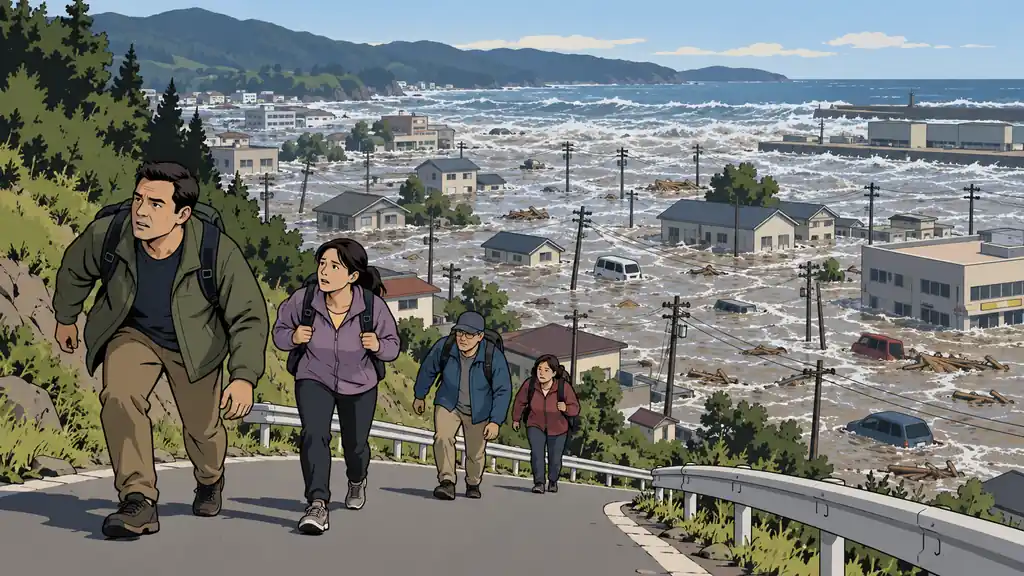
A tsunami strips preparedness down to its rawest form. There’s no stockpile to build, no room to seal, no generator to run. On exposed coastal ground, exactly one thing decides the outcome: can you get high enough, fast enough, in the minutes you have? Everything else is noise.
This threat rates an 8 for impact — devastating where it lands, though the coast around it stays intact to help you rebuild — and a 2 for likelihood, because only a handful of coastlines are meaningfully exposed. For those coastlines, the low probability is cold comfort. When it comes, it comes fast, and it doesn’t forgive a slow start.
Why “minutes and feet” is the whole story
A tsunami is not a wind wave. It’s the whole column of water getting shoved out of place — usually by a big undersea earthquake, and rarely by a landslide or a volcanic collapse. That’s why it acts nothing like the surf. It doesn’t crest and break and pull back. It arrives as a fast, sustained surge — the sea rising and flooding inland and staying up — often in a series of surges, with a later one sometimes bigger than the first. It carries debris that makes even shallow water lethal, and the current can move faster than you can run.
Two facts about the physics run your entire response:
- It’s fast. From a near-field earthquake — one close to your coast — the surge can be ashore in minutes. There may be no time for an official warning to reach you. The earthquake itself is the warning.
- Height beats it; distance helps. Water finds its level, so getting up — to high ground or a tall, strong building — is the reliable defense. Getting inland helps too, because the surge bleeds off energy crossing land, but on a flat coastal plain that can mean a long way. That’s why going up is usually the priority over going far.
And be clear about scale, because the movies lie. This is not a mile-high wall of water. It’s a flood measured in feet to tens of feet that keeps coming — and that’s plenty. Water only knee-deep but moving fast will take your feet out from under you. It doesn’t need to be tall to kill you; it needs to be moving, and it is.
What history actually teaches
The big modern events are worth knowing for the mechanism, not for memorizing body counts:
- The 2004 Indian Ocean tsunami, from a magnitude 9.1 megathrust quake off Sumatra, killed roughly 227,000 people across 14 countries — the deadliest on record. It showed how one undersea earthquake can wreck coastlines across an entire ocean, and how many people didn’t recognize the natural warnings, including the sea pulling far back before the surge.
- The 2011 Japan (Tōhoku) tsunami, from a magnitude 9.0 quake, killed roughly 18,000–20,000 people and reached run-up heights near 40 meters (about 130 feet) in places. Japan had world-class warning systems and seawalls, and still took catastrophic losses where the water overtopped the defenses. The lesson isn’t that engineering is useless. It’s that high ground beats hardware — a wall has a design height the wave can exceed, and ground doesn’t.
- U.S. exposure sits in the Pacific: Alaska, the Cascadia subduction zone off the Pacific Northwest, Hawaii, and the West Coast. Cascadia is the one to understand, because a great quake there would put much of the coast in the near-field — shaking as your warning, and only 10 to 30 minutes to reach high ground before the first surge. Cascadia’s great quakes recur on the order of every ~500 years on average, the last one struck in 1700, and the USGS puts the odds of a full-margin magnitude-9 event in the next 50 years at roughly 10–15%.
The common thread across all of them: the survivors were overwhelmingly the people who moved to high ground immediately, on the natural warning, without waiting for anyone to confirm it.
Likelihood — low, but a light switch, not a dial
The likelihood of 2 reflects a hard geographic truth. For most of the population this is a non-issue. For a specific set of coastlines it’s a genuine, recurring threat. There’s almost no middle. If you’re not in an inundation zone and don’t visit one, your honest rating is near zero. If you live, work, or vacation in an exposed coastal area, your personal odds are real and the consequence is maxed out — which is exactly the profile that earns serious, if simple, preparation.
So the practical rule is blunt: this threat is entirely about whether you’re in the zone. Settle that first. It decides whether any of the rest applies to you.
Work the clock
Here’s the only equation a tsunami cares about, and it’s made of two numbers.
How long until the water arrives versus how long it takes you to reach high ground. If your nearest high ground is a 20-minute walk and the surge arrives in 15, your plan is already broken — you need a closer high spot or a tall building, and you need to know that today, not while the ground is still shaking. If high ground is a 10-minute walk and you’ve drilled it, you have margin. That’s the whole calculation. Preparation doesn’t shrink the wave; it shrinks the second number until it’s comfortably smaller than the first.
What preparedness looks like
For the exposed, four disciplines — all about time and elevation, none about supplies.
1. Know your zone, precisely
Find out whether your home, your workplace, your kids’ schools, and the beaches you frequent sit inside a tsunami inundation zone — the area that would flood. Coastal jurisdictions publish inundation maps and post evacuation signs. Get specific. Not “am I near the coast,” but “is this address in the zone, and if so, where’s the nearest edge of it, uphill?“
2. Pick your high ground and walk the route on foot
Choose your destination: the nearest ground high enough to clear the flooding, or a designated vertical-evacuation structure (a tall, strong building or an engineered tower you go up in when there’s no time to go inland). Then walk the route yourself, because:
- Roads and bridges may be broken or jammed after the earthquake. Assume you’re on foot.
- You need to know how long it takes — that’s the number you check against the arrival time.
- Everyone in the family, including kids and anyone with mobility limits, should have walked it too.
Pre-walking turns a panicked decision into a rehearsed movement. It is the single highest-value thing you can do.
3. Make “shaking = go” a family rule
The behavior that saves you is acting on the natural warning without waiting for confirmation. Set the rule out loud: at the coast, strong or long shaking, or the sea pulling back or acting strange, means move to high ground now — no gathering belongings, no waiting for a siren or a phone alert. For a near-field event the natural signs are the warning, and the official alert may never beat the water. Rehearse the decision until it’s reflex.
4. Enroll in tsunami alerts (they still matter)
Sign up for your area’s tsunami warning notifications and keep a NOAA or emergency radio. For a distant (far-field) tsunami — generated across the ocean — you may get hours of real warning, and the alert system is worth its weight. For a near-field event the shaking is your primary warning and the alert is a backup. Know which one your coastline faces, because it changes which warning you’re really counting on.
Bottom Line
- It’s a light switch, not a dial — negligible for most, maxed out for a few exposed coastlines. Settle which you are first.
- You can’t out-supply or outrun it. The only defense is elevation, reached fast.
- The earthquake is the warning. At the coast, strong shaking or a withdrawing sea means move now, before any alert.
- Pre-walk your route to high ground on foot and know the time it takes. Assume the roads are gone.
- Enroll in tsunami alerts — they buy real time for a distant tsunami even when the shaking warns you of a near one.
A tsunami can’t be fought and can’t be outrun on flat ground — it can only be climbed above. Your whole preparation is a pre-walked path to high ground and the discipline to take it on the shaking, not the siren.
Map your high ground and pre-walk an on-foot evacuation route from any coastal address with the Area Recon tool.