


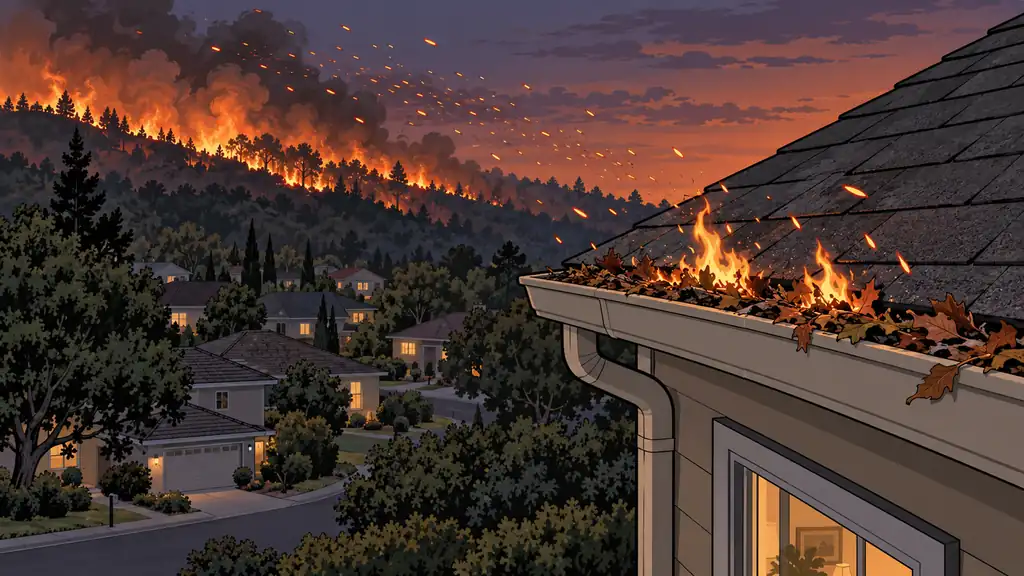
There’s a stubborn picture of wildfire as a wall of flame that either reaches your house or doesn’t. It’s mostly wrong, and being wrong gets people killed. The way homes are actually lost in the wildland-urban interface — the WUI, where houses meet wild brush and timber — is embers. Wind-driven sparks land on and around the house, often well ahead of the flames and well after them, find something dry to catch, and start the house burning from a spark. Once you understand that, your whole approach flips. You stop hoping the fire misses you and start building a house and a yard that give an ember nothing to catch.
This threat rates a severe impact of 8 out of 9 against a low likelihood of 2 out of 9. That split is the key to planning it right. For most of the country, a wildfire threatening your home is genuinely uncommon — that’s why the national likelihood sits low. But it isn’t spread evenly. In fire country it’s a seasonal certainty, and when it comes the impact is near-total home loss and real risk to life. If you live in the WUI, treat this as a top-priority threat no matter what the national average says, because your local number is far higher.
Three ways a house catches — and where to spend your effort
Interface fires get into a structure three ways, and knowing them tells you exactly where the work pays off.
1. Embers — the big one. Post-fire surveys by NIST and the insurance industry’s IBHS put the majority of WUI home losses — a figure often cited near 90% — on embers, not on direct flame. Wind lofts burning bark, needles, and wood fragments and carries them ahead of the fire, commonly up to a mile, and in extreme wind far more — NIST found Camp Fire embers igniting structures more than 20 miles ahead of the front. Those embers pile up in the same receptive spots every time: roof valleys, needle-choked gutters, vent openings, the base of walls, under decks, mulch beds. That’s not fighting the fire; that’s giving the ember nothing to catch.
2. Radiant heat. A big flame front close by can radiate enough heat to ignite the house or crack a window without ever touching it. This is what cleared space near the structure defends against.
3. Direct flame. Fire reaching the house along an unbroken fuel path — a line of brush, a wood fence running into the wall, a woodpile stacked against the siding. Break the fuel path and you break this one.
All three come down to managing fuel and openings. You’re not fighting fire. You’re removing its opportunities.
The pattern repeats, house to house
You don’t need invented figures to see it — the pattern across major interface fires is remarkably consistent. Investigators keep finding a house standing untouched right next to a burned-out one on the same street, and the difference is rarely luck. It’s the cleared first five feet, the screened vents, the metal roof instead of the wood shake, the absence of a woodpile against the wall — the same signatures IBHS and NIST document again and again in their post-fire walk-throughs. The 2018 Camp Fire that destroyed Paradise, California, is the reference case: 85 people killed and roughly 19,000 structures destroyed in a single wind-driven morning. And in the deadly fires, the deaths cluster among people who left late and got caught in their cars on jammed roads, or who never left at all. The two lessons — harden and clear the home, leave early — are written into every big event.
Know your real number, not the average
The 2 out of 9 is a national average, and it’ll mislead you if you take it at face value. Your real likelihood depends on:
- The fuel around and near your property — brush, timber, grassland.
- The slope. Fire moves faster uphill; homes on slopes and in canyons and chimneys run hotter risk.
- The season. How long and how severe your dry, fire-prone stretch is.
- The history. Land that has burned before will burn again.
If you’re in the WUI in fire country, your personal number may be several points above the average. Get a real read on your own address instead of trusting the headline.
The common mistakes people make
A few errors show up over and over, and each one is avoidable:
- Waiting for the mandatory order. By the time it comes, the roads are clogging. The people who die late-evacuating were often waiting to be told. Leave on your own trigger, earlier.
- The 1/4-inch vent screen. Coarse screen looks like it’s doing the job and lets embers straight through. The fine mesh is a different thing entirely (more below).
- Wood mulch and a woodpile against the house. That’s a fuse laid right to your siding. The first five feet is exactly where it can’t be.
- A go-bag assembled during the emergency. If you’re packing while the ridge is glowing, you’ve already lost the margin. It’s staged during the season, not built during the fire.
What preparedness looks like
Organize the work by zone and by decision.
Defensible space, by zone. Manage fuel outward from the house in bands:
- Immediate zone (about the first 5 feet): the highest-leverage ground. Keep it essentially non-combustible — no bark mulch, no dead leaves, no firewood, no flammable plants, nothing under the deck. This zone alone changes your ember odds dramatically.
- Intermediate zone (out to ~30 feet): cut and break up the fuel — mow, space out shrubs and trees, clear the low branches that let a ground fire climb into the canopy, keep it lean and broken up.
- Extended zone (~30 to 100 feet, terrain permitting): thin the vegetation and break up the continuity so an approaching fire loses intensity before it reaches the house.
Home hardening — close the ember doors.
- Vents: screen every vent with fine non-combustible metal mesh. California’s wildfire building code (Chapter 7A) calls for 1/16- to 1/8-inch openings; the coarse 1/4-inch screen is not good enough. Attic, crawlspace, eave, and gable vents are the classic ways embers get sucked inside.
- Roof and gutters: keep them clear of needles and leaves; favor Class A / non-combustible roofing over wood shake as you replace it; consider gutter guards.
- Walls, decks, windows: clear combustibles away from the walls; dual-pane or tempered glass resists cracking from radiant heat; close in the underside of decks.
- Fencing: a wood fence is a fuse running to the house — a non-combustible section where the fence meets the wall breaks it.
The evacuation decision — the part that saves lives.
- Decide your trigger now. Not a feeling — a defined event. “Fire visible on that ridge.” “Smoke column building to the west with the wind toward us.” “The first advisory, not the mandatory order.” Write it down. Leave early — the margin you’re imagining isn’t there once the roads clog.
- Go-bag, staged and current: documents (or copies), medications, water, N95s, chargers, cash, a change of clothes, pet needs, and the irreplaceables (photos, heirlooms, etc.). Ready during fire season, not thrown together during the emergency.
- More than one way out: know at least two routes, because your first one may be cut off or gridlocked.
- A communication plan: how the household reunites and stays in touch if you’re separated, and how you’ll get official word when cell and power are out.
Smoke, even if you never evacuate.
- N95 or P100 masks on hand, and a way to clean your indoor air — seal the house, run a filter or a box-fan filter, and know a cleaner-air place to go if your own becomes unbearable. Wildfire smoke fouls the air for hundreds of miles, reaching far more people than the flames.
Bottom Line
- Embers, not the flame wall, cause most home losses — so your defense is denying embers anything to catch, especially in the first five feet.
- Know your real local number, not the 2/9 average — the WUI in fire country is a far higher personal likelihood.
- Work the zones — a non-combustible immediate zone, thinned intermediate and extended zones, and fine-mesh screened vents on a hardened house.
- Decide your evacuation trigger and leave early — late on jammed roads is where the deaths happen.
- Plan for smoke and displacement — both reach far beyond the fire and last well past it.
The fire doesn’t decide whether your house survives — the choices you made months earlier do. In the interface, preparedness is landscaping, carpentry, and a decision written down in advance.
Start with an honest read of your own exposure — the county Threat Report shows whether wildfire is a live factor where you live, and Area Recon helps you map defensible space, ways out, and the terrain that shapes your risk.