


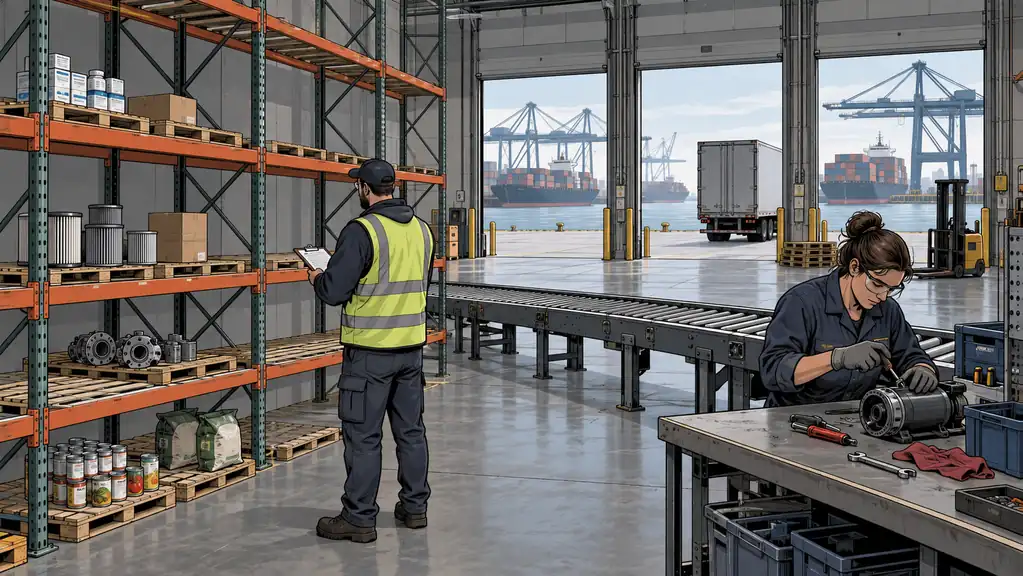
The global supply chain is the national one’s failure, blown up to full size. Both run just-in-time — make it and ship it exactly when it’s needed, keep almost nothing on the shelf. Both fall over when the flow stops and the thin buffers drain. The only difference is how big and how long. A national breakdown is a domestic problem you can, in principle, fix at home. A global collapse cuts the international arteries — shipping, ports, factories that span borders, and the fuel that moves all of it — so the shortages hit more categories, run longer, and can’t be fixed by anything inside your own country’s control. That’s not a bad week at the grocery store; that’s a season of scarcity across the board. It rates impact 7, likelihood 2: a serious hit that depth at home offsets, at odds that are real but low.
Why the impact is higher and the odds are lower
The impact beats the national version for three reasons.
- Breadth. Global manufacturing means almost every product has an imported part somewhere in it. So the shortages don’t hit one aisle — they hit across the board.
- Duration. Fixing an international shortage needs ships, ports, factories, and cooperation across borders to all come back at once. That’s far slower than a domestic patch.
- No substitute. Some things are made only overseas. There’s no domestic version to switch to at any speed.
The odds are lower than the national version because it takes a bigger, rarer shock to break the world system rather than dent one country’s — a major war touching key regions or shipping straits, a global pandemic, a chain of failures stacking up. The recent near-misses are familiar: the COVID-19 pandemic snarled global shipping and factories for the better part of two years, and in 2021 a single ship stuck in the Suez Canal for six days held up an estimated $10 billion a day in world trade. Neither was a full collapse. Both showed exactly how the machine breaks.
How the machine breaks
The same dynamics that sink the national chain apply here, only worse:
- Thin buffers everywhere. Just-in-time is the whole planet’s habit now. Nobody holds much inventory, at any point, so the system has almost no give.
- Everything from one place. Enormous shares of critical goods come from a handful of countries or even single factories. Taiwan makes more than 90% of the world’s most advanced computer chips. China refines roughly 90% of the world’s rare-earth elements. A large share of the active ingredients in Western medicines comes from China and India. Cut off one of those and you cut off the world’s supply of an input — and when that input feeds thousands of finished products, a narrow disruption shows up as scarcity everywhere.
- A few narrow doorways. Most of world trade moves by sea, funneled through a small number of straits, canals, and megaports. A blockage or a conflict at one doorway ripples across the globe. And the whole thing floats on fuel — a global energy disruption is a global everything disruption.
- Countries make it worse. When goods get scarce, nations slam the door — export bans, hoarding at the country level, grabbing supply for their own people. Rational for each country, brutal for everyone together. It turns a regional problem into a worldwide one.
What it actually looks like
It starts like an ordinary shortage — gaps showing up in weeks three through six — but instead of recovering, it keeps going and keeps spreading:
- Many categories at once. Food (a lot of which rides on imported fertilizer, fuel, and packaging), medications, medical devices, electronics, replacement parts, manufactured goods — all tightening together.
- Medications, sharpened. This is the dangerous one. A large share of drugs and their raw ingredients are made overseas, there’s no quick domestic substitute, and running out is a medical problem, not an inconvenience.
- Factories go quiet too. Missing an imported part idles a domestic assembly line, so even “made here” goods go short.
- Prices climb, then things vanish. Sustained scarcity drives prices up, and pushes some goods off the shelf entirely for a while.
The reason a prepared household still comes through is that this stays, underneath it all, an availability problem. Brutal for the unprepared — bridgeable for anyone with depth and the ability to make and substitute.
The common mistakes
- Panic-buying at the start. Trying to build depth in week one, in the crush, at the top of the price. Depth is built slowly, in calm times, as ordinary shopping.
- Stocking food and forgetting parts. A full pantry and a dead water filter with no spare cartridge is still a failure. The collapse gaps parts, not just products.
- Skipping the medication problem. It’s the sharpest edge and the least substitutable — and the one people plan for last, if at all.
- Believing you can out-store it. Stores run down. In a months-long event, stockpiling alone hits a floor. The households that last are the ones that can make and fix.
A worked example: days of coverage
Don’t measure depth as “a full pantry.” Measure it as days of coverage per category — how many days each thing lasts at the rate you actually use it.
Say your household eats through 3 cans a day of a staple. 90 cans on the shelf is 30 days of that category. Want to bridge a three-month global event? You need about 270 cans — and a rotation habit so the oldest gets eaten first and nothing spoils waiting.
Run the same math on the things you can’t substitute. A prescription you take twice a day at a 90-count bottle is 45 days of coverage — so a 90-day disruption leaves a 45-day hole you have to close before it starts, by working ahead with your provider. Do this category by category and the vague worry “am I ready?” turns into a specific list of holes to fill.
What preparedness looks like
1. Go deeper than national depth — weeks to months. Because this runs longer and wider, extend your stores: weeks to months of the essentials you can’t easily substitute. Manage it as days of coverage per category, build it steadily as normal shopping, and rotate it so deep stock stays fresh. Same buffer habit as the national case — just sized to a longer event.
2. Stock consumables and spares. A global collapse gaps the parts that keep your systems running, not just your groceries. Stock the consumables you can’t substitute, and the spares for the equipment you depend on — water filters and cartridges, batteries, medical-device supplies, tools, repair components. When the replacement has to cross the ocean that’s the problem, having the part on the shelf is the difference between a working system and a dead one.
3. Build the skill to make and fix — this is the differentiator. Stockpiling has a floor: eventually the stores run out. What makes global-collapse prep last is the ability to produce and repair, which regenerates instead of depleting. Learn to grow and preserve food — a garden plus canning, drying, and root-cellaring stretches your food supply indefinitely. Learn to repair instead of replace — basic mechanical, electrical, and household fixes. Learn to improvise and substitute — making do with what’s on hand. Every skill you build is one less thing you need a ship to deliver. Measure this in what you can make or fix yourself, not what you bought.
4. Plug into a resilient local economy. When the global web frays, local is the fallback — and it’s a strong one. Get to know nearby food producers — farms, ranches, mills, gardeners — local tradespeople, and your broader community. Build the trust that makes barter work: trading goods, skills, and labor when normal commerce is impaired. A community where people make different things and help each other is far more resilient than any one household’s stockpile. That’s the prep that scales best in a long, broad disruption.
Bottom Line
- The whole world runs on empty shelves by design — a global collapse means broad, lasting shortages, worst for imported goods.
- It’s rarer but more severe (impact 7, likelihood 2) — low odds, high consequence, offset by depth at home.
- Go deeper — weeks to months — of non-substitutable essentials, and hold spares for critical equipment, not just consumables.
- Build the skill to make and fix — it regenerates your supply and cuts your dependence on the broken chain; it’s what separates this from national prep.
- Plug into a local economy — nearby producers, tradespeople, and barter are the answer when distance is the problem.
Globalization made everything cheap by spreading it across the world. A collapse turns that same distance into scarcity — so pull your supply lines close: deep at home, strong in your community, rich in skills no ship has to deliver.
Build your weeks-to-months of depth and rotate it with the Food & Water Storage tool, and start growing part of your own supply with the Garden Planner.