


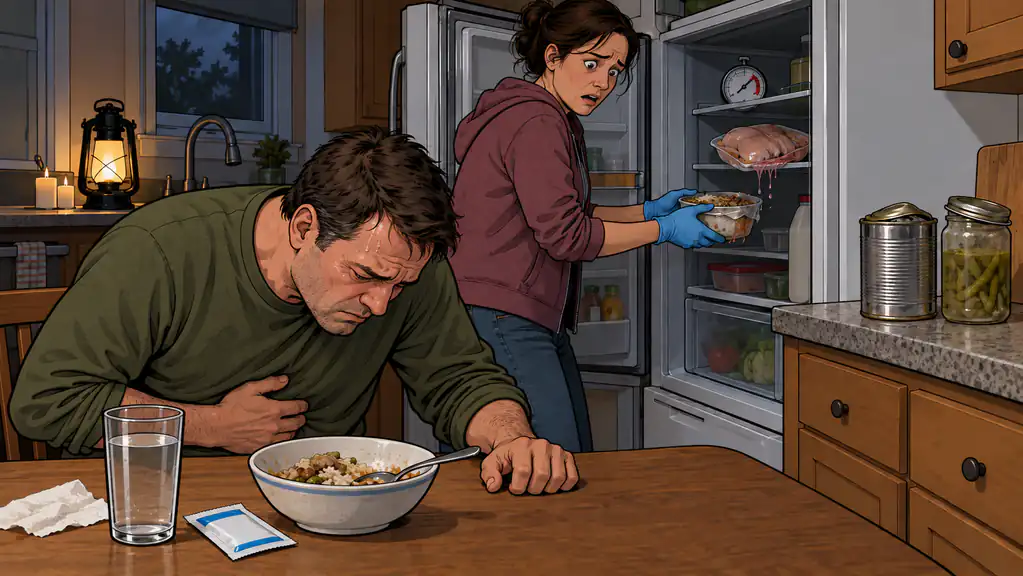
Preppers accumulate food. More freezers, more canned and dry goods, more home preservation — and every one of those adds a new way to get food poisoning. That’s the uncomfortable part: the household most invested in storing food is the one with the most chances to get it wrong. On its own, a case is a bad day or two. Layered on top of the exact emergency you built the stockpile for — no power, no clean water, no clinic — it stops being trivial. This is about running the mechanism so your safety net stays safe.
High odds, but the impact isn’t fixed
Food poisoning scores high on likelihood and low on impact, and both are right — but that low impact number is an average, and the average hides the tail. For a healthy adult on a normal week, it’s self-limiting; you’re miserable, then you’re fine. For the very young, the elderly, pregnant women, and anyone with a weakened immune system, the same bug can drive dangerous dehydration or worse. And for anyone during a grid-down or water-compromised event, the supportive care that makes it minor — rest, clean fluids, an easy trip to replace food — is exactly what’s gone. So the impact isn’t a fixed number. It’s a function of who got sick and what conditions you’re in.
The mechanism: the danger zone and time
Most foodborne illness is a numbers game with bacteria. Salmonella, Campylobacter, E. coli, Listeria, and toxin-makers like Staph aureus and Clostridium perfringens multiply fastest in what the USDA calls the temperature danger zone — 40°F to 140°F. In that band, bacteria can double in as little as 20 minutes.
Sit with that for a second, because it’s exponential and people underestimate it. Doubling every 20 minutes means 6 doublings in 2 hours — a 64-fold jump. Leave the same food out for 4 hours and it’s 12 doublings, roughly 4,000 times the bacteria you started with. That’s the whole reason the rule is what it is: perishable food shouldn’t sit in the danger zone more than 2 hours total — cut to 1 hour above 90°F. It’s not fussiness; it’s the math of doubling.
Two special cases matter for preppers:
- Cooking is not a reset button. Some bacteria produce heat-stable toxins. Once food has been left out and the toxin has formed, reheating kills the bacteria but leaves the poison behind. “I’ll just cook it hot” doesn’t undo abuse.
- Botulism changes the stakes. Clostridium botulinum thrives in low-oxygen, low-acid conditions — the exact inside of an improperly home-canned jar of vegetables, meat, or other low-acid food. It’s rare, potentially fatal, and you can’t smell it, see it, or taste it. That’s why canning procedure is non-negotiable and not a place to freelance.
The same handful of mistakes, every time
You don’t need a headline outbreak to see the pattern; it’s in ordinary kitchens. Illness clusters around a few repeatable errors: cross-contamination from raw meat to food you won’t cook, temperature abuse (a cooler that drifted warm, a deep pot of leftovers cooling slowly on the counter, a fridge quietly failing), undercooking poultry and ground meat, and time — food kept and eaten well past when it should have been tossed because it “looked fine.” CDC outbreak investigations single out the same short list again and again. The good news buried in that: the failure modes are known and preventable with process, not luck.
The one threat that will actually happen
On our scale this sits near the top for likelihood, and that’s honest — periodic food poisoning is close to a lifetime certainty. The CDC estimates about 48 million Americans get a foodborne illness every year, which works out to roughly 1 in 6 of us annually. Norovirus causes the most cases; Salmonella causes the most hospitalizations and deaths. The value in saying it plainly is calibration: the highest-probability threat on your whole list deserves real, if modest, attention — not just the dramatic long-shots. And the prep is cheap while the payoff is frequent.
The cascade is why it earns a slot
At home, the direct hit is acute gastroenteritis: fluid and electrolyte loss through vomiting and diarrhea, cramping, sometimes fever. Dehydration is the through-line to every serious outcome — it’s what sends the vulnerable to the hospital, and what makes an average case dangerous when clean water is scarce.
In an emergency, it dominoes:
- A sick adult is a capable adult removed from the household’s labor right when you need everyone working.
- Illness burns through water faster — the sick person needs more, and cleanup needs more — draining reserves ahead of plan.
- Sanitation load climbs (waste, laundry, wiping down surfaces) exactly when sanitation may be degraded, opening a path for the bug to spread to the next person.
One stomach bug in a grid-down house can turn into a water shortage plus a second and third case. That’s not a bad day; that’s a preparedness problem.
What preparedness looks like
Build a small system around the mechanism.
Control the cold chain.
- Keep an appliance thermometer in both the fridge (hold ~34–40°F) and the freezer (0°F or below). It’s cheap, and it’s the only thing that catches a slowly failing compressor before it spoils a whole load.
- Know your outage timeline before it happens: a full freezer holds safe temperatures far longer than a half-empty one, and a fridge only a few hours once you start opening it. Have the plan — coolers, ice, “eat the fridge first, then the freezer” — ready before the power’s out, not during.
Control time and temperature.
- Respect the 2-hour rule, and cool leftovers fast in shallow containers instead of letting a deep pot coast down through the danger zone for hours.
- Date and rotate everything, oldest first. A stockpile without dates is a guessing game, and guessing is how the vulnerable get hurt. When in doubt, throw it out — a few dollars of food is nothing against a sick household.
Control contamination.
- Dedicated handling for raw meat: separate boards, wash hands and surfaces, don’t reuse marinades. Cook poultry and ground meat to a safe internal temperature with a food thermometer — don’t eyeball it.
Respect home preservation.
- If you can, follow tested, current procedures — pressure-can low-acid foods at the right times and pressures. Treat canning as engineering, not folk art, because botulism is the reason. If a jar’s seal, smell, or look is off, discard it without tasting.
Stage the treatment.
- Keep oral rehydration salts (or the recipe and the ingredients) plus dedicated clean water set aside for illness. This is the highest-value item in the whole plan: it’s what keeps a routine case from becoming a dehydration emergency, and it matters most for kids and elders.
- Basic anti-diarrheal and anti-nausea meds where appropriate, and a plan to isolate and clean up after a sick person to stop the spread.
Measured in time, this is a few one-time habits plus a periodic check of your thermometers and dates — the cheapest insurance on your entire food program.
Bottom Line
- This is the threat you’ll actually meet — near-certain over a lifetime, so build the cheap habits now.
- Impact isn’t fixed — mild for a healthy adult, serious for the vulnerable or during an outage when supportive care is gone.
- The danger zone (40–140°F) and the 2-hour rule are the mechanism — bacteria double every 20 minutes, so control time and temperature and you prevent most cases.
- Date, rotate, and toss when in doubt — an undated stockpile is a liability, and home canning is procedure, not improvisation.
- Stage oral rehydration — it’s what turns a dangerous case back into a merely miserable one.
The most probable emergency you’ll ever face is also the cheapest to prepare for. A thermometer, a dating habit, and rehydration salts keep your stockpile from becoming the thing that makes you sick.
Use the Food & Water Storage worksheet to date, rotate, and flag your stores before anything drifts past safe.